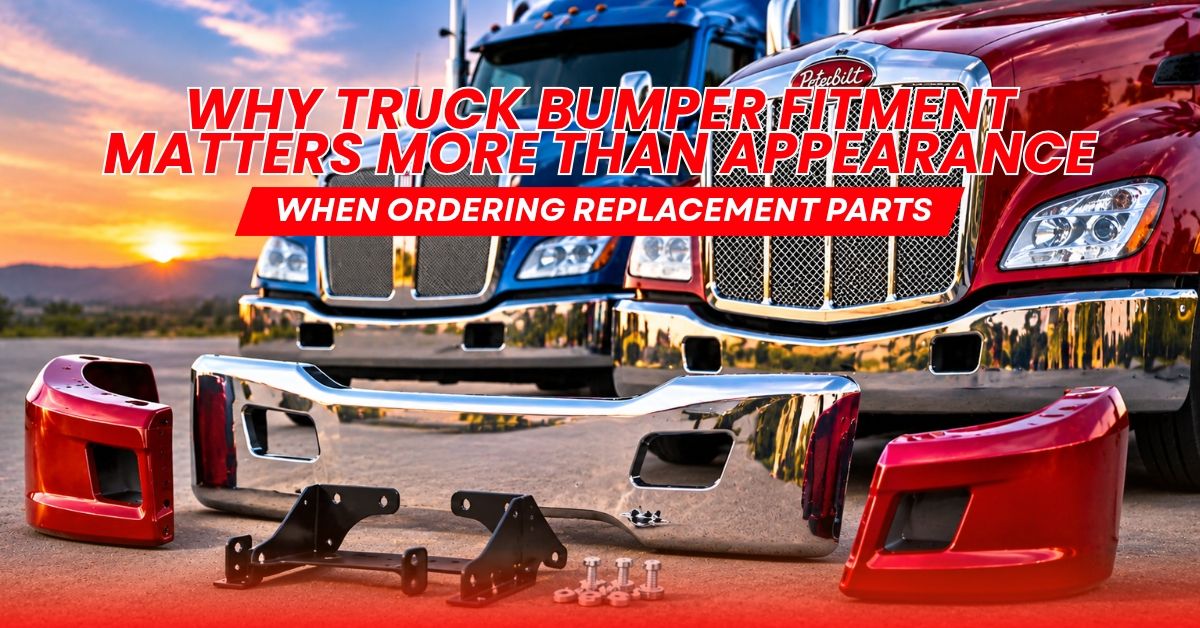
For commercial truck owners and fleet managers, ordering replacement parts is a routine business decision. However, even something as straightforward as replacing a damaged bumper can become an expensive mistake when the wrong component is purchased.
Two semi truck bumpers may look nearly identical in product photos, yet differences in mounting brackets, dimensions, model years, and equipment configurations can make them incompatible.
For businesses operating multiple trucks, these mistakes can create unnecessary downtime, additional shipping expenses, and delays in scheduled maintenance.
Whether you’re replacing a Peterbilt bumper, a Kenworth T680 bumper, or another commercial truck component, choosing the correct replacement requires more than matching its appearance.
Understanding bumper fitment can help truck owners make better purchasing decisions and avoid costly installation problems.
Why Bumper Fitment Is a Business Issue
Commercial trucking depends on vehicle availability.
When a truck is out of service, the business may need to adjust delivery schedules, arrange another vehicle, or postpone planned work.
A damaged bumper can already create maintenance expenses. Ordering an incompatible replacement can make the situation worse.
Consider a fleet maintenance team that orders a bumper based on a product photograph without checking its mounting configuration.
When the part arrives, the technicians discover that the brackets do not align with the truck.
The business may then need to return the part, pay additional shipping charges, and wait for the correct replacement.
The original repair has now become a larger operational problem.
This is why purchasing the correct semi truck parts matters as much as selecting components at a reasonable price.
A properly matched bumper helps maintenance teams complete repairs efficiently and return vehicles to service without unnecessary complications.
1. Similar-Looking Truck Bumpers May Have Different Mounting Requirements
One of the most common misconceptions about replacement bumpers is that similar-looking components are interchangeable.
Commercial truck manufacturers produce different models, configurations, and generations.
Even within the same model family, bumper designs can change over time.
Mounting Brackets and Attachment Points
Bumper assemblies connect to the vehicle through specific mounting brackets and attachment hardware.
The location and design of these mounting points can vary.
A replacement bumper may have the correct general shape but still fail to align with the truck’s existing brackets.
Before ordering, buyers should verify:
- Mounting hole locations
- Bracket compatibility
- Bumper dimensions
- Required attachment hardware
- Vehicle model and production year
- Original equipment part numbers
If the existing bumper was damaged in an impact, the supporting brackets should also be inspected.
Installing a new bumper onto damaged mounting hardware may create alignment problems even when the replacement itself is correct.
2. Peterbilt Bumper Replacement: Why Model Identification Matters
Peterbilt trucks are widely used in commercial transportation, but their bumper configurations vary by model and production details.
A bumper intended for one Peterbilt model may not fit another.
For example, replacement components designed for a Peterbilt 579 should not automatically be assumed compatible with a Peterbilt 389 or 567.
What to Check When Buying a Peterbilt Bumper
Before ordering, confirm the truck’s:
- Exact model
- Production year
- Existing bumper part number
- Mounting bracket arrangement
- Bumper dimensions
- Material and finish
- Lighting or equipment provisions
The replacement should also accommodate the truck’s original configuration.
Some bumper assemblies may have openings or mounting provisions for specific equipment.
If these features differ, the replacement may require additional components or may not be suitable for the vehicle.
For truck owners comparing Peterbilt bumper replacement parts, reviewing the individual product specifications is an important step toward avoiding incorrect orders.
Why the Cheapest Bumper May Not Be the Best Purchase
Price is an important consideration, especially for businesses maintaining several trucks.
However, a lower purchase price does not automatically translate into lower repair costs.
If a bumper requires unexpected modifications, additional hardware, or replacement because of incorrect fitment, the total expense can exceed the initial savings.
Buyers should compare compatibility, construction quality, included components, and supplier policies before making a decision.
3. Kenworth T680 Bumpers: Understanding Multi-Piece Assemblies
The Kenworth T680 presents another example of why bumper fitment requires careful attention.
Depending on the truck’s configuration, its bumper assembly may include multiple replaceable components.
These can include center sections, bumper corners, brackets, and lower panels.
Center Bumper Sections
The center section forms the middle portion of the bumper assembly.
On certain configurations, it may be available as an individual replacement component.
However, buyers must verify whether the center section is compatible with the existing bumper corners and mounting hardware.
Left and Right Bumper Corners
Bumper corners are positioned toward the outer edges of the truck.
These components can be particularly vulnerable to damage during tight maneuvering or contact with obstacles.
When ordering, buyers should confirm whether they need the driver-side or passenger-side component.
Left and right bumper corners are not necessarily interchangeable.
Mounting Brackets
Mounting brackets support the bumper assembly and help maintain its proper position.
A damaged bracket can cause a replacement bumper section to sit unevenly or fail to align correctly.
Before ordering a new component, maintenance teams should inspect the surrounding hardware.
For a detailed explanation of individual components, QSC Truck Parts offers a guide to Kenworth T680 bumper parts, brackets, and fitment.
Understanding the difference between these components can help businesses determine whether they need a complete bumper assembly or a smaller replacement part.
4. Model Year and Truck Generation Can Change Fitment
Commercial truck designs evolve.
Manufacturers may introduce new body styling, mounting arrangements, aerodynamic features, or equipment configurations.
As a result, a replacement part designed for an earlier model may not fit a newer version of the same truck.
Why Production Details Matter
When purchasing replacement bumpers, buyers should avoid relying on model names alone.
For example, knowing that a vehicle is a Kenworth T680 or Peterbilt 579 may not provide enough information to identify the correct bumper.
The truck’s production year, generation, and applicable equipment details can affect compatibility.
Use Part Numbers Whenever Possible
Original equipment part numbers can help identify suitable replacements.
When comparing aftermarket components, check whether the supplier provides compatible part-number references.
If the original number is unavailable, use the truck’s VIN and relevant vehicle specifications to confirm the correct application.
Product photographs can help with visual comparisons, but they should not be the only source of fitment information.
5. Hidden Damage Can Complicate a Bumper Replacement
A bumper may appear to have only cosmetic damage after a minor impact.
However, the visible exterior panel does not always reveal the full extent of the problem.
Mounting brackets, support components, and adjacent body panels may also be affected.
Signs of Possible Hidden Damage
Maintenance teams should look for:
- Uneven bumper alignment
- Gaps between adjacent panels
- Bent mounting brackets
- Cracked attachment points
- Loose or missing hardware
- Difficulty aligning replacement components
- Damage to nearby lighting assemblies
If the mounting structure is damaged, replacing only the exterior bumper may not restore proper fitment.
Identifying these issues before ordering can help the business purchase all necessary components at once.
This is particularly valuable for fleets trying to minimize the time a truck spends in the repair shop.
6. OEM vs. Aftermarket Semi Truck Bumpers
Commercial truck owners often choose between original equipment manufacturer (OEM) components and aftermarket alternatives.
Both options can be appropriate when the replacement meets the vehicle’s requirements.
OEM Replacement Bumpers
OEM components are specified for particular vehicle applications.
They may be preferred when maintaining original equipment configurations and finishes is a priority.
However, pricing and availability can vary.
Aftermarket Replacement Bumpers
Quality aftermarket semi truck parts can provide additional purchasing options for truck owners and fleet managers.
Depending on the manufacturer and product, aftermarket bumpers may offer competitive pricing and suitable replacements for commonly used truck configurations.
The important consideration is whether the component matches the vehicle.
Before purchasing, compare:
- Vehicle compatibility
- Mounting requirements
- Material specifications
- Finish and construction quality
- Included hardware
- Warranty information
- Return policies
- Availability and shipping requirements
Businesses should evaluate the total cost of the repair rather than focusing exclusively on the purchase price.
7. The Real Cost of Ordering the Wrong Truck Bumper
An incorrect bumper order can affect several areas of a trucking business.
The cost is not limited to the replacement component itself.
Additional Shipping Expenses
Returning an incompatible part may involve return shipping charges or restocking fees, depending on the supplier’s policies.
If the correct replacement is needed urgently, expedited shipping may create additional expenses.
Increased Labor Costs
Maintenance technicians may spend time attempting to identify why a bumper does not fit.
They may also need to remove the incompatible component and prepare for another installation.
This creates labor costs without completing the original repair.
Vehicle Downtime
A truck waiting for replacement parts may be unavailable for scheduled work.
The business may need to rearrange routes or assign another vehicle.
Administrative Work
Incorrect orders also create additional work for purchasing and maintenance teams.
Employees may need to coordinate returns, verify replacement specifications, and update repair schedules.
These expenses demonstrate why fitment verification is an important part of responsible purchasing.
For a broader discussion of business financial planning, Insiders Business explains why businesses need budgets.
Applying the same budgeting principles to fleet maintenance can help companies anticipate replacement costs and avoid preventable spending.
8. How Fleet Managers Can Improve Replacement-Part Purchasing
Businesses operating multiple commercial trucks can benefit from a standardized purchasing process.
Instead of treating every bumper replacement as an entirely new order, fleet managers can maintain accurate records of compatible components.
Maintain Vehicle-Specific Parts Records
Useful information includes:
- Vehicle identification number
- Truck make and model
- Production year
- Original bumper part numbers
- Previously purchased compatible replacements
- Mounting bracket specifications
- Equipment configurations
- Supplier information
These records can help reduce repeated research and ordering mistakes.
Document Common Repairs
If a particular bumper corner or bracket frequently requires replacement, maintenance teams can document the component and its correct part number.
This information may be useful when planning future purchases.
Confirm Parts Before Scheduling Repairs
Whenever possible, verify the required components before assigning the truck to a repair appointment.
This can reduce the risk of discovering missing or incompatible parts after the vehicle has already been taken out of service.
Track Total Repair Costs
Fleet managers should consider parts prices, shipping, labor, and downtime when evaluating suppliers.
This provides a more complete picture of maintenance expenses.
For additional fleet purchasing guidance, see Insiders Business’ earlier article on reducing fleet parts costs without buying cheap parts.
While cost control is important, selecting the correct components remains essential to efficient fleet operations.
9. Finding Reliable Semi Truck Parts in Orange County
Southern California supports a substantial commercial transportation network.
Truck owners and fleet managers operating throughout Orange County, Los Angeles, Riverside, and surrounding communities often depend on replacement parts for ongoing maintenance.
When searching for semi truck parts Orange County, buyers should prioritize accurate product information and vehicle compatibility.
A dependable supplier should make it easier to identify the appropriate component.
What to Look for in a Parts Supplier
Before purchasing, consider whether the supplier provides:
- Detailed product descriptions
- Model-specific compatibility information
- Clear part-number references
- Product photographs
- Mounting and equipment details
- Transparent shipping information
- Return and warranty policies
For businesses maintaining several vehicle makes, access to multiple replacement-part categories can also simplify purchasing.
Truck owners can explore semi truck parts through QSC Truck Parts, including replacement components for popular commercial truck models.
The objective is to select parts that meet the vehicle’s specifications while supporting efficient maintenance planning.
10. A Practical Checklist Before Ordering a Replacement Bumper
Before finalizing a purchase, truck owners and fleet maintenance teams can use the following checklist.
Vehicle information
- Confirm the truck make and model.
- Verify the production year and generation.
- Record the VIN or relevant configuration details.
Existing bumper condition
- Identify the damaged components.
- Inspect mounting brackets and surrounding hardware.
- Check adjacent lighting and trim components.
Replacement specifications
- Compare original and replacement part numbers.
- Verify dimensions and mounting locations.
- Confirm driver-side or passenger-side designation where applicable.
- Check equipment and lighting compatibility.
Purchasing details
- Review what is included with the replacement.
- Confirm availability and shipping expectations.
- Check warranty and return policies.
- Compare the total expected repair cost.
Completing these checks before ordering can help reduce avoidable mistakes and make the replacement process more predictable.
Frequently Asked Questions
Are Peterbilt bumpers interchangeable between different models?
Not necessarily. Peterbilt bumper designs and mounting configurations can vary by model, production year, and equipment specifications. Buyers should verify compatibility before purchasing.
Can I install a Kenworth T680 bumper on any T680 model year?
No. Different T680 generations and configurations may use different bumper components. Confirm the vehicle’s exact specifications and applicable replacement part numbers.
Can a damaged bumper bracket cause fitment problems?
Yes. Bent or damaged mounting brackets can prevent a replacement bumper from aligning correctly, even when the bumper itself is compatible.
Are aftermarket semi truck bumpers a good option for fleet maintenance?
Quality aftermarket bumpers can be suitable when they meet the vehicle’s fitment and performance requirements. Buyers should evaluate compatibility, construction quality, and supplier reliability.
Is it cheaper to replace one bumper section instead of the entire assembly?
It can be, depending on the bumper design, availability of individual components, and extent of the damage. A complete inspection helps determine which parts require replacement.
What information should I provide when ordering semi truck bumper parts?
Provide the truck make, model, production year, VIN or relevant configuration details, original part number when available, and information about the damaged component.
Final Thoughts: Correct Fitment Protects More Than Your Truck
Replacing a damaged semi truck bumper may seem like a straightforward maintenance task, but ordering the wrong component can create additional costs and operational delays.
Differences in mounting brackets, model years, bumper sections, and equipment configurations make accurate part selection essential.
For fleet managers, verifying compatibility before purchasing can help reduce unnecessary shipping expenses, installation problems, and vehicle downtime.
Whether you’re replacing a Peterbilt bumper, Kenworth T680 bumper, or another exterior component, the best purchasing decision is one that balances compatibility, durability, availability, and total repair cost.
For truck owners and fleet operators comparing aftermarket semi truck parts, QSC Truck Parts offers replacement options for multiple commercial truck makes and models.
Taking a little extra time to confirm the correct part can help businesses keep repairs organized, control maintenance expenses, and return trucks to service more efficiently.